Search for answers or browse our knowledge base.
-
Social
-
Environmental
-
- Articles coming soon
-
- Articles coming soon
-
- Articles coming soon
-
Economic
-
- Articles coming soon
-
- Articles coming soon
-
- Articles coming soon
-
-
Governance
-
- Articles coming soon
-
- Articles coming soon
-
- Articles coming soon
-
Values primer
Common Cause
This article is a summary compiled from material publicly available from the website of Common Cause Australia, the expert consultancy, founded in the UK but active also in Australia. Their website is https://www.commoncause.com.au/ We acknowledge their authorship of the material and thank them for making it available to inform the debate on how community organisations can frame their advocacy in terms of the shared values we hold dear.
An introduction to values
“What are values?
Values are the principles or standards that each of us carry through our lives that guide and inform our thoughts, attitudes and actions. They influence, and are influenced by, our experience of the society in which we each live. Our values help determine what is important to us and shape how we interact with each other and all living beings in the world around us.
Why are values important?
We might not be explicitly aware of them, but values are important influences in many aspects of our lives, such as our choice of friends, what we buy, if and how we vote, our ecological footprints, and our personal wellbeing. They also influence how we act on social and environmental issues, such as poverty, climate change and racism. If we are to overcome the world’s most pressing challenges, we need to elevate the human values that underpin our care for each other and the wider world.
What do we mean by intrinsic and extrinsic values?
Some values are referred to as extrinsic values. These values rely on external approval or rewards – such as wealth, power or public image. Other values are referred to as intrinsic values. These values are more inherently rewarding – such as community, love for friends and family and creativity. Both groups of values play an important part in who we are – to live well-rounded lives we need to be able to draw on a wide range; but it is also important that these values are kept in balance.
How can values lead to a better world?
When we look at some of the key sources of influence in mainstream culture – for example, advertising, the media and government – we can see that they champion and foreground some values more than others. Through an overemphasis on wealth, celebrity and consumerism, our culture has become skewed towards extrinsic values, undermining the intrinsic values which lead to greater care for each other and the wider world. Despite these powerful influences, most people nonetheless prioritise intrinsic values over extrinsic, which we can see as a powerful indicator of the potential to rebalance the values we find all around us. Building our social institutions, business and public services in ways that reflect intrinsic values would deepen our care for one another, strengthen responses to social and environmental issues, and improve personal wellbeing.”
NCV Values
Set out below are the ten shared values that all Members of NCV have agreed to abide by and are the fundamental principles by which we run our organisation. Together with carefully researched evidence, they guide how we arrive at decisions, how we behave towards each other, shape our vision of what we want for our collective future and how we expect to be governed.
1. Acknowledgement of First Nations people:
NCV recognises the ancestral connections and custodianship of Traditional Owners throughout Australia and works towards reconciliation.
2. Raising the standard of political representation:
NCV aims to move beyond traditional party politics, focusing on community needs and preferences through communication of the voices of our community expressed as a broad range of desired outcomes.
3. Community engagement:
NCV emphasises involving everyday people in political processes at all three levels of government through respectful dialogue and inclusivity, evidence-based decision-making and valuing diverse perspectives.
4. Safety from violence, coercion and addiction
NCV believes everybody, particularly women, children and vulnerable minorities, must be able to live in safety, free from acts and threats of violence, abuse, intimidation and the scourge of addiction.
5. Representative Accountability:
NCV believes in empowering the community to take an active role in the political process and hold their representatives accountable for achieving constituents’ desired outcomes within reasonable timeframes.
6. Climate Action:
NCV promotes strong climate policies, actions to reduce carbon emissions and a just transition away from fossil fuels to renewable energy, sustainable housing and transport.
7. Integrity, transparency and accountability:
NCV advocates for independent bodies to investigate and eliminate corruption and ensure ethical behaviour, transparency and accountability at all three levels of government.
8. Socially and culturally progressive, economically and environmentally responsible:
NCV encourages adoption of progressive values and maintains strong support for the care economy, prudential economic management and protection of natural environments and biodiversity.
9. Long-Term Thinking and Appropriate Action:
NCV promotes the importance of strategic long-term planning, tackling challenging issues and acting in accordance with the laws and norms of civil society.
10. Equality of opportunity for all people:
NCV advocates for equality of opportunity for all people regardless of their gender, sexual orientation, age, disability, race, or national or ethnic origin.
Discussion
The material below is extracted from resources downloaded from the website of the Common Cause consulting and training organisation: https://www.commoncause.com.au/resources
“Our mission is to shift cultural values to create a more equitable, sustainable and democratic society.”
“Values shape people’s beliefs about what is desirable, important, or worthy of striving for in their lives.
Psychologists have identified several groups of values but this report focuses on just two: compassionate values and selfish values. These two groups are of particular relevance to people’s social and environmental concern, people’s motivation to express this concern through various forms of civic action, and people’s feelings of social connectedness…..
Compassionate values include: ‘broadmindedness’, ‘a world of beauty’, ‘a world at peace’, ‘equality’, ‘protecting the environment’, ‘social justice’, ‘helpfulness’, ‘forgiveness’, ‘honesty’ and ‘responsibility’. Values in this group are associated with greater concern about social and environmental issues, and greater motivation to engage in various forms of civic action. These are known to academics as ‘self-transcendence’ values and encompass some of the ‘intrinsic’ values.
Selfish values include: values of ‘wealth’, ‘social recognition’, ‘social status’ and ‘prestige’, ‘control or dominance over people’, ‘authority’, ‘conformity’, ‘preserving public image’, ‘popularity’, ‘influence’ and ‘ambition’. Selfish values are associated with lower concern about social and environmental issues, and lower motivation to engage in various forms of civic action. These are known to academics as ‘self-enhancement’ values and they are similar to ‘extrinsic’ values.”
The Common Cause Handbook shows 10 groups of values:
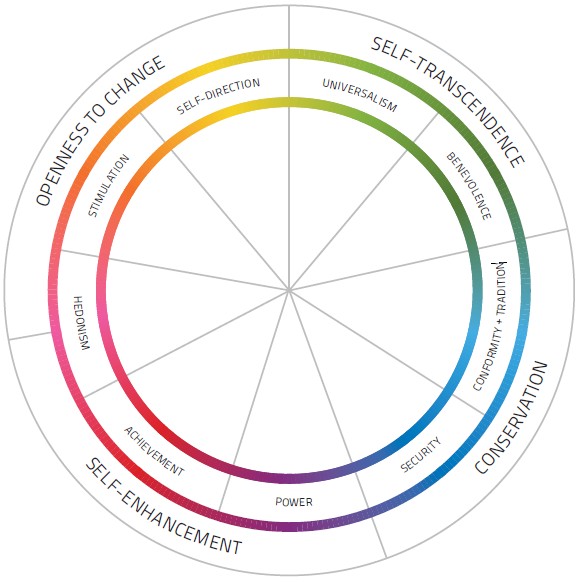
Figure 1: Ten Values Groups
It also shows how they can be represented in a circular diagram with contrasting values depicted across diametrically opposite axes (i.e. the top two segments are the types NCV are trying to encourage):
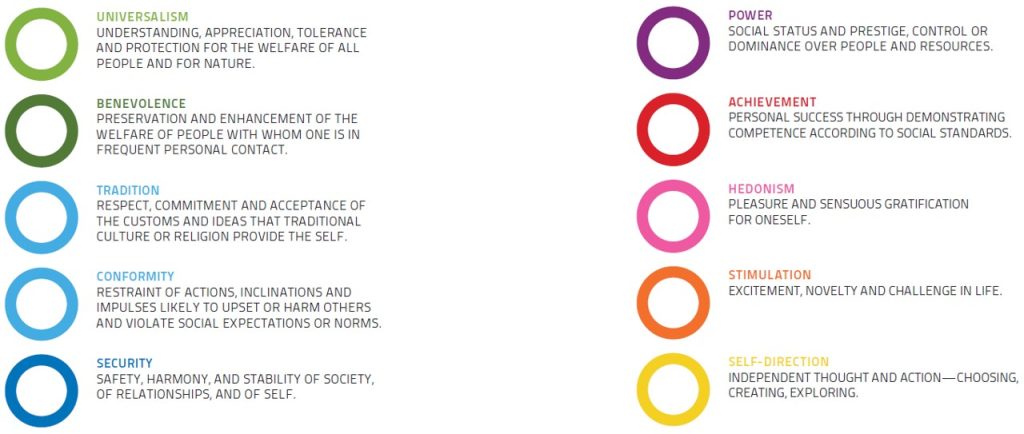
Figure 2: Schwartz’s Circumplex Model
The extracts below highlight material from their free documents that resonate with the way we are trying to embed our 10 values as a fundamental feature our NCV planning, management and operations. After reviewing this material, we should contemplate how we can adopt this, with our 10 values, into our approach.
Framing values to facilitate communication
“Values and the issues we face:
Prioritising intrinsic values such as freedom, creativity and self-respect self-direction values), or equality and unity with nature (universalism values) is closely related to political engagement, concern about social justice, environmentally-friendly behaviours, and lower levels of prejudice.”
Reinforcing frames:
Over time, frames become embedded in our thinking and discourse through repeated exposure. The frames most prominent in our minds provide communicative shortcuts. These can provide helpful shortcuts or unhelpfully distort our thinking. Frames such as the ‘bloated civil service’ and ‘taxpayers’ money’ provoke negative reactions to the idea of public spending. An alternative framing might refer to ‘public funds.’ Frames thus help us define the roles of actors and institutions. Through framing we understand how things work—but also how things should work.”
“Explore Values:
Values and frames open up new avenues for analysis, exploration and intervention: how they are expressed in economic structures, underpin behaviour and institutions, and emerge in our own strategies and practices.
Nurture intrinsic Values:
No aspect of our work is ever entirely value-free, instead both embodying and reinforcing certain values and frames. We should therefore aim not only to promote intrinsic values in communications but to embed them across all areas of our work.
Challenge extrinsic values:
Various elements of our society and culture help foster the desire for wealth, social recognition and power—and simultaneously diminish care for people and the environment. Addressing these will be essential in making progress.
See the big picture:
The benefits of appeals to extrinsic values—in motivating rapid or significant policy changes—may occasionally outweigh the ‘collateral damage’ they cause. Without a clear understanding of values, however, we will not be able to identify and manage these trade-offs effectively. We must not lose sight of the big picture, and a vision of long-term, systemic change, with a clear understanding of the values that will underpin it.
Work together:
Clearly, no one group or organisation is likely to have much of an impact in shifting values on its own. We need to cooperate and collaborate —both within and across different sectors—to be effective. Because diverse issues are linked by the values that underpin them, we will be continually supporting each other through our efforts”
“Communication, education, facilitation:
Taking values into account doesn’t detract from the importance of the messages we communicate. However, doing so should highlight the values embedded in all aspects of the experience of that message: in the setting, the frames, the level of participation it offers, and the messenger. The type, and depth, of engagement is also significant. A low-involvement experience—reading a leaflet, for instance—is likely to engage with values fairly superficially, while top-down communications may stifle the expression and development of self-direction values. First-hand experience and deeper involvement are likely to have a much greater impact, and self-direction values are more likely to be engaged where self-expression and critical thought are facilitated and encouraged.
Advocacy, lobbying and policy work:
Institutions, policies and social structures play a central role in shaping our lived experience. How can we find out what the full impact of these might be, taking values into account? There are values embedded in the use of economic indicators as a proxy for societal success, for instance. What policies could better embody the appreciation of others and of nature, creativity, and fair opportunities for all?
Organisation, supporters, finance and fundraising:
People’s overall experience of organisations will serve to reinforce particular values—and not always those being explicitly promoted. Our relationship with the people we work with can therefore be important. Holding a participatory meeting in a community space embodies very different values from a formal meeting encouraging deference to hierarchical structures. Similarly, financially successful models or techniques often allow limited scope for engagement with those you’re working with (and often have a high churn of members, supporters or employees). An example is the civil society model of professionalised protest businesses’ with direct debits as the deepest level of engagement. What organisational models best embody the values we wish to promote?
Creation and action:
Creation and engagement in practical activities, particularly the promotion of creativity for its own sake (and not for rewards or recognition), are often strongly related to self-direction values, which in turn tend to be strongly related to values supportive of social and environmental justice. While many projects embody this ethos and these values already, there may be more points where more people can be encouraged, engaged and included.
Support and communities:
Support and community services could promote self-direction values and be carried out in highly compassionate ways; at other times they may promote conformity, social order, and deference to authority. If the end goal is the care of others (related to intrinsic values), then ensuring the values embodied are aligned with the methods may be important; if not, they may erode the very values and outcomes strived for.”